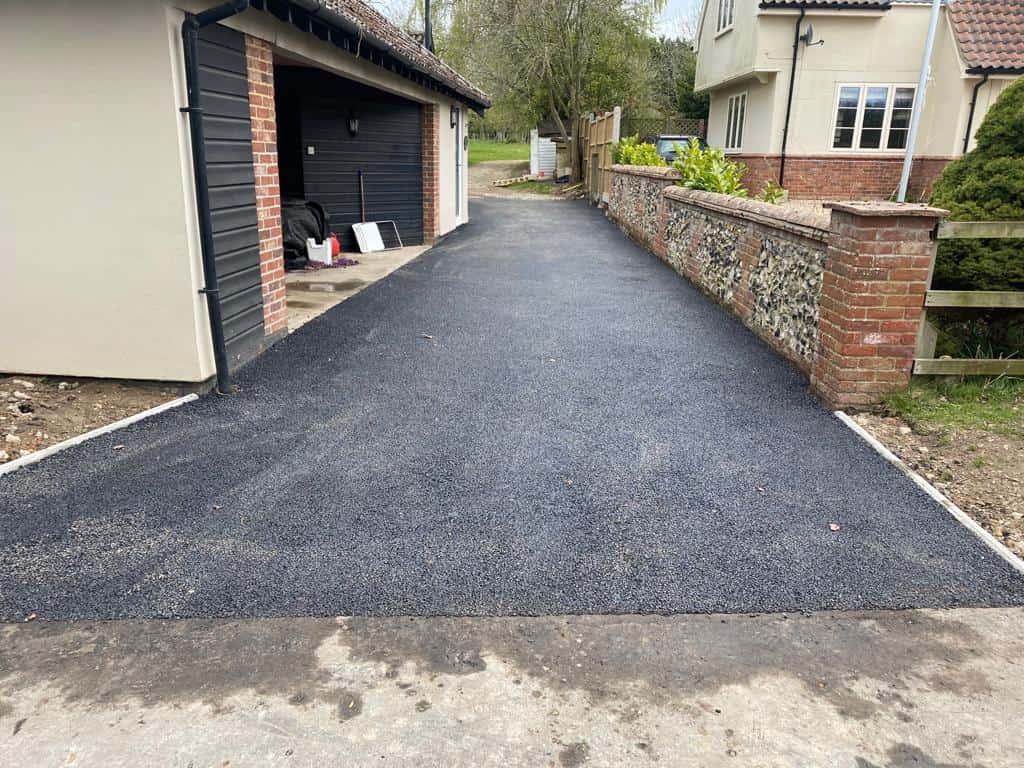
What Makes a Residential Tarmac Installation Durable?
A residential tarmac driveway may appear relatively simple once completed, but its durability depends on considerably more than the visible surface. The quality of the preparation underneath, the stability of the supporting layers, drainage, compaction, edging and the way the driveway is designed for everyday use all contribute to how well it performs over time.
This is why two tarmac driveways can look similar when newly installed yet behave very differently as they age. A well-prepared surface has been constructed as a complete pavement system, with each layer performing a particular function. By contrast, applying tarmac over unsuitable or poorly prepared ground can leave underlying weaknesses that eventually become visible at the surface.
For homeowners in Gillingham, Kent, understanding what makes a tarmac installation durable is useful when planning a new driveway or replacing an existing surface. Good workmanship begins with the ground beneath the tarmac and continues through every stage of construction.
What Determines the Durability of a Tarmac Driveway?
A durable residential tarmac installation depends on several elements working together rather than one particular feature.
Important considerations include:
- Correct preparation of the existing ground
- A suitable and stable sub-base
- Effective compaction throughout construction
- Appropriate surface levels
- Sensible management of surface water
- Secure and properly planned edges
- Suitable construction for expected vehicle use
- Correct installation of the tarmac layers
- Careful treatment around entrances and transitions
- Attention to weak areas before surfacing begins
The finished tarmac is important, but its performance is closely connected to everything supporting it.
Ground Preparation Creates the Starting Point
Every driveway begins with the existing site.
Before a new surface can be constructed, the condition of the ground needs to be understood. Soft areas, unsuitable existing materials and inconsistent levels can all affect the stability of the finished driveway.
Simply covering these weaknesses does not remove them.
Appropriate preparation creates a more dependable platform on which the remaining driveway construction can be built. This stage may ultimately become invisible, but it has a substantial influence on long-term performance.
The Sub-Base Supports the Driveway
Beneath the visible tarmac is a supporting construction designed to distribute the loads placed on the driveway.
For a residential surface, those loads commonly come from cars and the repeated movement associated with parking, turning and entering or leaving the property.
A suitably prepared sub-base helps distribute these forces rather than allowing them to become concentrated within weak sections of ground.
If the supporting layer lacks stability, movement underneath can eventually be reflected through the tarmac above.
Why Sub-Base Depth Cannot Be Considered in Isolation
It can be tempting to think that durability simply comes from using more material beneath the driveway.
In reality, the required construction depends on the site, ground conditions and intended use.
Depth alone does not guarantee stability if the material is unsuitable or has not been properly compacted.
Professional driveway construction therefore considers the complete supporting system rather than relying on one measurement as a universal solution.
Compaction Is Fundamental to Stability
Compaction helps supporting materials form a stable construction.
Without adequate compaction, voids and loose areas can remain beneath the finished surface. These may settle under repeated vehicle loading, potentially creating depressions or movement above.
Good compaction should therefore take place during the construction process rather than being treated as something that can be corrected after the tarmac has been installed.
A durable driveway depends on creating stability before the final surface is laid.
Soft Spots Should Be Addressed Before Surfacing
If an isolated section of the prepared area remains soft or unstable, covering it with tarmac does not strengthen the ground underneath.
Instead, that weakness can become the location where deterioration first appears.
The surface may begin to dip, deform or show signs of cracking as the supporting material moves.
Identifying and addressing unsuitable areas during preparation helps create more consistent support across the complete driveway.
Drainage Plays an Important Role in Durability
Water management should be considered during the design and preparation of a tarmac driveway.
A well-planned surface needs appropriate levels so that rainfall can move away rather than repeatedly collecting in depressions.
Standing water can also be an early indication that surface levels have not been formed effectively or that settlement has occurred.
Drainage should therefore be incorporated into the construction from the outset rather than considered only after the driveway has been completed.
Surface Falls Need to Be Deliberate
A driveway that appears almost flat may still require carefully established falls.
These subtle changes in level help guide surface water in the intended direction.
Creating suitable falls requires planning because the driveway must relate properly to entrances, surrounding ground and other adjoining surfaces.
Small differences in level can make a significant practical difference to how effectively rainfall moves across the completed tarmac.
Edges Help Support the Finished Surface
The perimeter of a tarmac driveway deserves particular attention.
The central area is surrounded by the rest of the driveway, whereas the edges transition into neighbouring surfaces such as lawns, planting areas or other hard landscaping.
Without appropriate edge support, the margins can become more vulnerable to deterioration and movement.
Well-planned edging helps maintain a clearly defined boundary and contributes to the integrity of the finished surface.
Edge Construction Should Be Planned Before Tarmac Is Laid
Edging should form part of the driveway design rather than being treated as an afterthought.
Its position affects the width, shape and appearance of the completed surface.
It can also influence transitions between the driveway and neighbouring areas.
Establishing edges during the preparation stage provides a clear framework for the tarmac installation and helps produce a more controlled, consistent finish.
The Driveway Should Be Designed for How It Will Actually Be Used
Residential driveways are not all used in the same way.
Some provide straightforward parking, while others involve frequent turning, multiple vehicles or repeated manoeuvring within a relatively small area.
These patterns matter because vehicle forces are not distributed equally across every part of the surface.
A driveway should therefore be considered in relation to its expected everyday use rather than simply its overall dimensions.
Turning Areas Can Experience Greater Stress
Areas where vehicles regularly turn can experience different forces from sections used mainly for straight-line movement.
Tyres rotating or changing direction while a vehicle is moving slowly can place additional stress on the surface.
Good construction beneath these areas is therefore particularly important.
The complete driveway should provide consistent support so that regularly used turning points do not become premature weak spots.
Entrances Are Frequently Used Sections
The entrance to a residential driveway receives vehicle traffic every time the property is accessed.
It may also need to meet another surface at a different level or construction.
These transitions need careful attention.
Poorly formed changes in level or inadequately supported edges can create vulnerable points. Proper preparation helps ensure that the entrance functions as an integrated part of the driveway rather than a weak connection at its boundary.
Tarmac Thickness Is Only One Part of the Construction
The visible surfacing layer needs to be suitable for its intended use, but simply increasing its thickness cannot compensate for poor preparation beneath it.
A strong-looking surface installed over unstable ground can still move.
Durability comes from the relationship between the foundation, supporting layers and finished tarmac.
Each component needs to perform correctly rather than expecting the surface course to overcome weaknesses elsewhere in the construction.
Consistent Installation Matters Across the Whole Driveway
A driveway is only as dependable as its weaker sections.
If most of the area is well prepared but one section receives inadequate support or compaction, deterioration may begin there.
Consistency during construction is therefore important.
Preparation, levels and compaction need attention throughout the driveway, including sections that may appear less important during installation.
Existing Driveways Need Proper Assessment Before Resurfacing
Where tarmac is being considered for an existing driveway, the condition of the current surface and supporting construction should be assessed first.
An old driveway that looks worn is not necessarily structurally unsuitable.
If the underlying construction remains stable, resurfacing may sometimes be an appropriate approach. Where significant settlement, movement or widespread structural deterioration is present, simply adding a new surface may leave those weaknesses unresolved.
The correct approach depends on what exists beneath the visible wear.
A New Surface Cannot Correct Significant Movement Underneath
Tarmac can provide a clean, uniform finish, but it should not be treated as a way of concealing structural problems.
If an existing driveway contains substantial depressions or unstable sections, those areas need appropriate attention before the final surface is installed.
Otherwise, movement can eventually transfer through the new material.
Assessing the cause of deterioration before resurfacing helps avoid treating symptoms while retaining the original weakness.
Localised Problems May Not Require Complete Reconstruction
Not every defect means the entire driveway construction has failed.
One isolated area may have settled while the remainder remains stable.
Where investigation confirms that deterioration is genuinely localised, targeted preparation may sometimes be sufficient before surfacing work continues.
A proportionate approach means addressing the areas that require intervention without automatically disturbing sound construction elsewhere.
The Finished Surface Needs Proper Compaction
Compaction remains important when the tarmac itself is installed.
The material needs to form a dense, consistent surface with appropriate levels and integration between sections.
Careful installation contributes to the smoothness and uniformity of the finished driveway.
This stage works together with the preparation beneath it. Good surfacing cannot compensate for a poor foundation, just as excellent groundwork still requires the tarmac to be installed correctly.
Consistent Levels Improve Both Appearance and Performance
A professionally constructed tarmac driveway should have a coherent surface profile.
Unexpected dips and irregularities can affect appearance, vehicle movement and water behaviour.
Establishing appropriate levels from the beginning allows the different parts of the driveway to work together.
This is especially important where the tarmac meets entrances, paths, paving or other existing features.
Connections With Other Surfaces Need Careful Detailing
Many residential driveways connect with paths, paved areas or other hard surfaces.
These junctions should be considered during planning.
A poorly formed transition can create an awkward step, weak edge or area where water repeatedly gathers.
Careful detailing helps the new tarmac integrate more naturally with the rest of the property while maintaining practical access.
Shape Can Influence How a Driveway Performs
The layout of the driveway affects where vehicles travel and where repeated loads occur.
Narrow sections, turning points and entrances can receive concentrated use, while other areas may experience comparatively little traffic.
Understanding these patterns allows the construction to be planned around real use rather than treating every driveway as a simple rectangular surface.
A practical design contributes to durability because it reduces avoidable stress and awkward vehicle movements.
Why Cracks Can Develop in Tarmac
Cracking can occur for several reasons, and the visible crack does not always identify the underlying cause.
Movement beneath the surface, weak supporting areas, deterioration at edges and changes within an existing construction can all contribute.
This is why repairing a crack effectively involves more than simply filling the visible opening.
Understanding why it developed helps determine whether the issue is superficial or connected to a deeper weakness.
Why Depressions Deserve Attention
A depression in a tarmac driveway can indicate that the surface or supporting construction has moved.
It may also create a location where rainfall repeatedly collects.
If the depression continues developing, simply treating the surface appearance is unlikely to provide a lasting solution.
The affected section should be assessed to determine whether the movement originates within the tarmac itself or from supporting layers underneath.
Durability Starts Before the Tarmac Arrives
Much of what determines the lifespan and reliability of a tarmac driveway is established before the visible surface is installed.
Excavation, ground preparation, sub-base construction, compaction, drainage planning and edge formation all take place first.
Once the tarmac is laid, these stages are largely hidden.
This is why evaluating a driveway purely by how smooth it looks immediately after installation provides only part of the picture. The quality of the unseen construction is equally important.
Good Workmanship Creates Consistency
Professional installation involves controlling each stage of the work rather than concentrating only on the final appearance.
The ground needs to be prepared appropriately, supporting materials installed consistently, levels established and edges properly formed before surfacing begins.
Attention to these details helps create a driveway that performs as one complete structure.
A durable installation is therefore the result of a sequence of correctly completed stages rather than one particular product or technique.
Maintenance Still Matters After Installation
Even a well-constructed driveway remains exposed to everyday use and outdoor conditions.
Occasional inspection can help identify changes before they become more extensive.
Edges, drainage behaviour and any developing surface defects are particularly useful areas to monitor.
The appearance of a small defect does not automatically indicate serious failure, but understanding why it has developed can help determine whether attention is needed.
Why Professional Tarmac Installation Matters
A durable residential tarmac driveway depends on decisions that are difficult to judge once the finished surface is in place.
At Gillingham Driveways, we consider the existing ground, intended vehicle use, supporting construction, levels, drainage and edges before the final surfacing is completed.
For homeowners in Gillingham, Kent, this approach helps ensure that the driveway is designed as a complete installation rather than simply a layer of tarmac placed over the existing ground.
The objective is straightforward: prepare the area properly, create suitable support and install the finished surface in a way that reflects how the driveway will actually be used.
Conclusion
The durability of a residential tarmac installation depends on much more than the visible surface. Proper ground preparation, a stable sub-base, thorough compaction, suitable drainage, well-supported edges and careful attention to levels all contribute to how effectively the driveway performs.
The supporting construction is particularly important because weaknesses beneath the tarmac can eventually become visible as settlement, depressions, cracking or uneven areas. A durable driveway therefore needs to be built correctly from the ground upwards.
If you are considering a new or replacement tarmac driveway in Gillingham, Kent, contact Gillingham Driveways. We can assess the area and recommend an appropriate surfacing approach based on the existing conditions and how the driveway needs to perform.
Call us on: 01634 564 190
Click here to find out more about Gillingham Driveways
Click here to complete our contact form and see how we can help with your driveway needs.